A flier created by the CDC's National Diabetes Education Program as a guide for patients in the management of medicines to treat diabetes. Available in English.
copy deeplink Clinician Consultation Center Substance Use Warmline
Clinician Consultation Center Substance Use Warmline
Substance Use Warmline
Peer-to-Peer Consultation and Decision Support
10 am – 6 pm EST Monday - Friday
855-300-3595
Free and confidential consultation for clinicians from the Clinician Consultation Center at San Francisco General Hospital focusing on substance use in primary care
Objectives of the Substance Use Warmline:
- Support primary care providers in managing complex patients with addiction, chronic pain, and behavioral health issues
- Improve the safety of medication regimens to decrease the risk of overdose
- Enhance the treatment, care and support for people living with or at risk for HIV
- Discuss useful strategies for clinicians in managing their patients living with substance use, addiction and chronic pain.
Consultation topics include:
- Assessment and treatment of opioid, alcohol, and other substance use disorders
- Approaches to suspected misuse, abuse, or diversion of prescribed opioids
- Methods to simplify opioid-based pain regimens to reduce risk of misuse and toxicity
- Urine toxicology testing- when to use it and what it means
- Use of buprenorphine and the role of methadone maintenance
- Withdrawal management for opioids, alcohol, and other CNS depressants
- Harm reduction strategies and overdose prevention
- Managing substance use in special populations (pregnancy, HIV, hepatitis)
- Productive ways of discussing (known or suspected) addiction with patients.
The CCC’s multi-disciplinary team of expert physicians, clinical pharmacists and nurses provides consultation to help clinicians manage complex patient needs, medication safety, and a rapidly evolving regulatory environment.
Learn more at http://nccc.ucsf.edu/clinician-consultation/substance-use-management
Files
- CCC Substance Use Warmline Flier EST 7.25.16.pdf (112.12 KB)
copy deeplink Working With Farm Animals: Keeping yourself, your family and your community health | Comic Book
Working With Farm Animals: Keeping yourself, your family and your community health | Comic Book
An educational comic book on the prevention of zoonotic illnesses. Developed by MCN in collaboration with Ohio State University.
Files
- Working with farm animals_1.pdf (13.33 MB)
- Trabajos con animales en un rancho_1.pdf (13.31 MB)
copy deeplink Clinician Guides for Farmworker Health and Safety Regulations
Clinician Guides for Farmworker Health and Safety Regulations
MCN and Farmworker Justice offer these guides to assist clinicians in understanding farmworker health and safety regulations. OSHA’s Field Sanitation Standard; EPA's Federal Insecticide, Fungicide, and Rodenticide Act (FIFRA); EPA's Food Quality Protection Act (FQPA); EPA’s Worker Protection Standard (WPS).
Files
- OSHA's Field Sanitation Standard Clinician's Guide.pdf (747.53 KB)
- FIFRA FQPA Clinician Guide.pdf (287.9 KB)
- WPS Clinician's Guide.pdf (843.35 KB)
copy deeplink Seguridad en palabras – Diccionario ilustrado bilingüe para la agricultura | COMIC
Seguridad en palabras – Diccionario ilustrado bilingüe para la agricultura | COMIC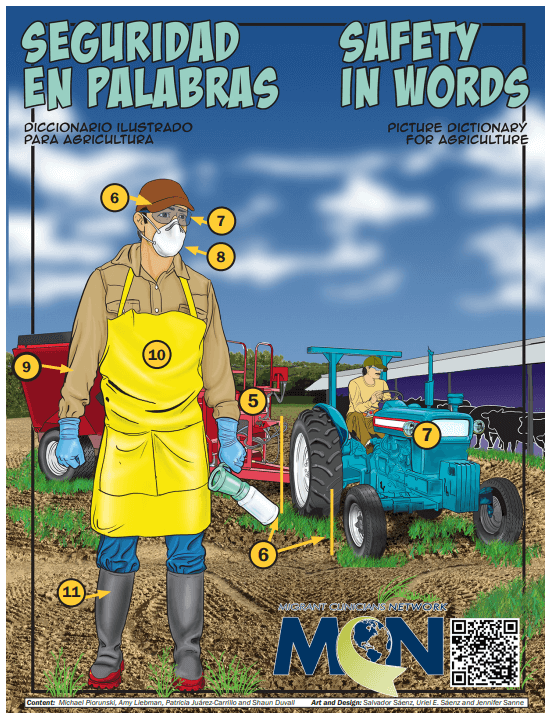
Este diccionario ilustrado bilingüe de MCN, "Seguridad en Palabras/ Safety in Words", muestra los peligros que hay en el lugar de trabajo y las mejores prácticas para la salud y la seguridad en la agricultura. Desarrollado con el apoyo del Programa de Subvenciones Susan Harwood de OSHA, este recurso refuerza el vocabulario en inglés de los trabajadores que hablan español lo que ayudará a prevenir lesiones en la agricultura.
Files
copy deeplink Safety and Health on the Farm: It's Your Right and It's the Law - Comic
Safety and Health on the Farm: It's Your Right and It's the Law - ComicThis colorful bilingual comic addresses workers' compensation and immigrant dairy farm workers’ rights and responsibilities. It tells the story of a Mexican dairy farm worker who is injured on the job and the steps he and his employer take to make sure he receives his benefits, and the farm improves its safety.
Files
- DairyWrkrRightsWrkComp_ENG2016_web.pdf (7.78 MB)
- DairyWrkrRightsWrkComp_ESP2016_web.pdf (7.92 MB)
- COMIC - Safety and Health on the Farm - New Mexico - English.pdf (3.4 MB)
- COMIC - Safety and Health on the Farm - New Mexico - Spanish.pdf (3.41 MB)
- COMIC - Safety and Health on the Farm - New York - English.pdf (3.45 MB)
- COMIC - Safety and Health on the Farm - New York - Spanish.pdf (3.46 MB)
- COMIC - Safety and Health on the Farm -Minnesota -English.pdf (7.78 MB)
- COMIC - Safety and Health on the Farm - Minnesota - Spanish_0.pdf (7.91 MB)
copy deeplink CAL POISON: Signs and Symptoms of Pesticide Exposure (VIDEO)
CAL POISON: Signs and Symptoms of Pesticide Exposure (VIDEO)Señales y síntomas de envenenamiento por pesticidas
Developed by the California Poison Control System in collaboration with the Western Center for Agricultural Health and Safety at the University of California, Davis and the California Department of Pesticide Regulation
copy deeplink Pesticide Exposure in Children - Policy Statement
Pesticide Exposure in Children - Policy StatementChildren encounter pesticides daily and have unique susceptibilities to their potential toxicity. Acute poisoning risks are clear, and understanding of chronic health implications from both acute and chronic exposure are emerging. Epidemiologic evidence demonstrates associations between early life exposure to pesticides and pediatric cancers, decreased cognitive function, and behavioral problems.
In this policy statement, the American Association of Pediatrics outlines the symptoms and suggested course of treatment for acute exposure pesticides belonging to the eight most predominant classes of pesticides. The policy statement also makes recommendations for both pediatricians and government to take measures to improve pesticide safety.
© AAP - 2012; This document is copyrighted and is property of the American Academy of Pediatrics and its Board of Directors.
Files
- PestExposureChild_Policy_AAP.pdf (523.63 KB)
copy deeplink ¡Cuídate! A Simple Guide for Preventing Muscle Injuries at Work | COMIC
¡Cuídate! A Simple Guide for Preventing Muscle Injuries at Work | COMIC¡Cuídate! is an educational resource on the prevention of musculoskeletal injuries at work. This comic is in Spanish, English and Haitian Creole.
Files
- injury prevention ENGLISH 2019.pdf (19.34 MB)
- injury prevention SPANISH 2019.pdf (11.9 MB)
- injury prevention WEB CREOLE AUG 14 2019.pdf (12.77 MB)
copy deeplink Cholinesterase (ChE) Testing Protocols and Algorithm for Healthcare Providers
Cholinesterase (ChE) Testing Protocols and Algorithm for Healthcare Providers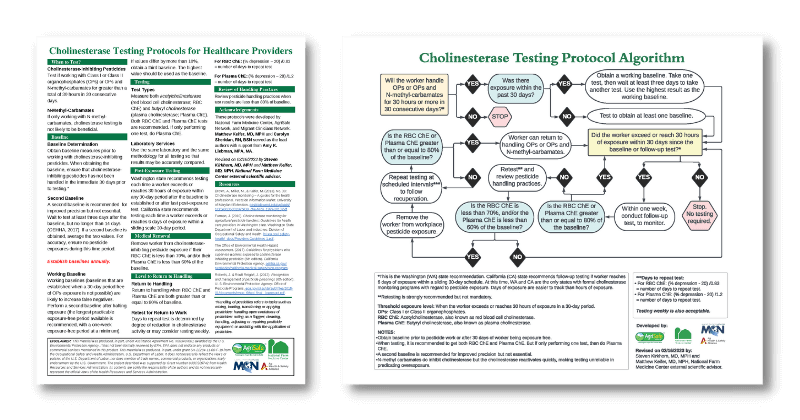
These Cholinesterase (ChE) clinical tools provide a concise and simple format to guide clinicians in monitoring the ChE levels for patients working with Class I and Class II organophosphates (OP) or OP and N-methyl-carbamates.
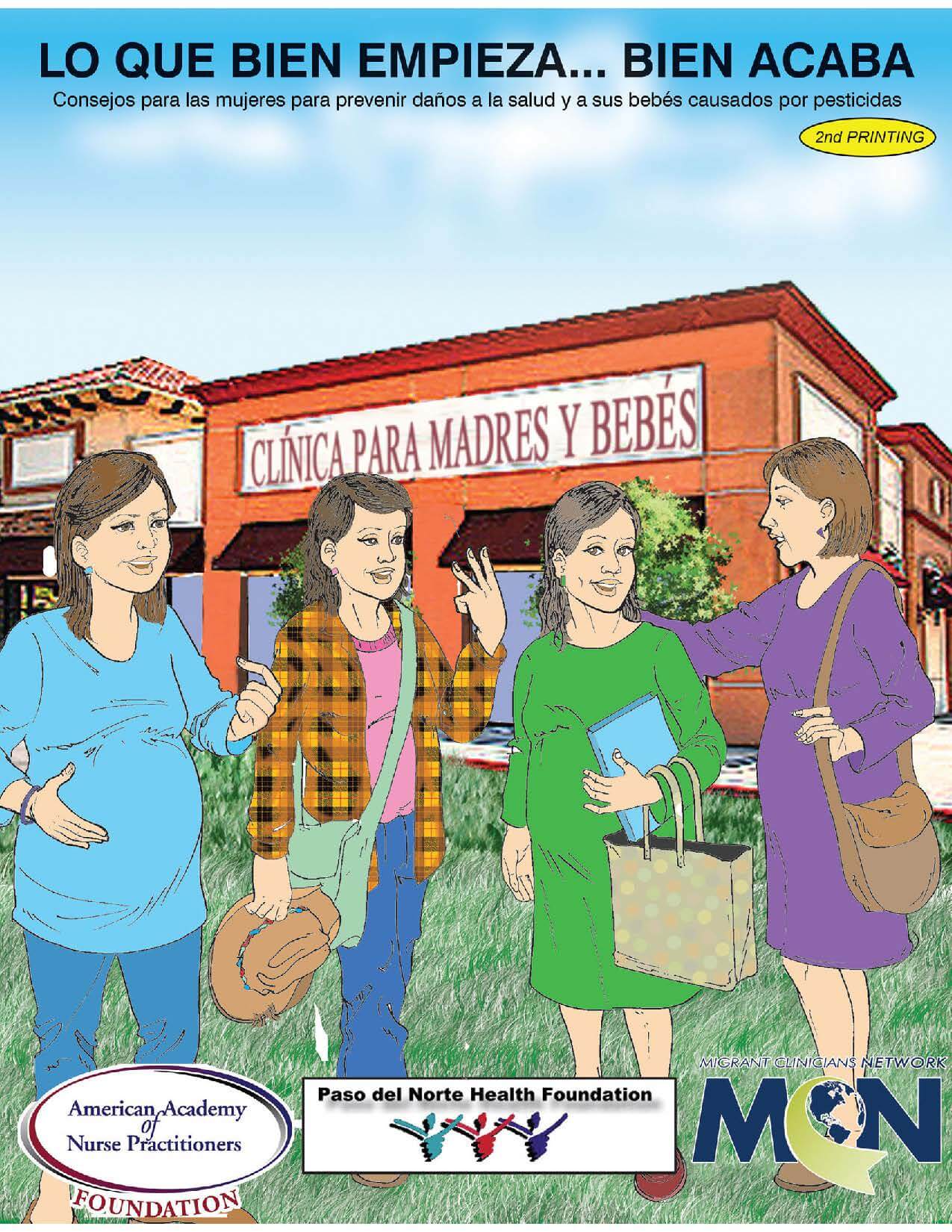
MCN Spanish educational comic book that addresses pesticide exposure in women of reproductive age. LO QUE BIEN EMPIEZA...BIEN ACABA: Consejos para las mujeres para prevenir daños a la salud y a sus bebés causados por pesticidas.
Files
- lo que bien empiezacomic 2015-20mb.pdf (16.45 MB)
copy deeplink Educational Brochures for Asthma, Lead and Pesticides
Educational Brochures for Asthma, Lead and PesticidesThree printable brochures on Asthma, Lead and Pesticides produced by Farmworker Justice.
Files
- SpanishBrochures.pdf (4.88 MB)
- EnglishBrochures.pdf (4.88 MB)
copy deeplink MCN Pesticide Exposure Clinical Guidelines and Assessment Form
MCN Pesticide Exposure Clinical Guidelines and Assessment Form
MCN's Pesticide Clinical Guidelines and Pesticide Exposure Assessment Form assist in the recognition and management of acute pesticide exposures in primary care settings.
The pesticide guidelines were adapted from guidelines developed by Dr. Dennis H. Penzell, a former medical director of a Community and Migrant Health Center with experience in large-scale pesticide exposure incidents.
The Acute Pesticide Exposure Form was adapted from the data collection on an acute pesticide exposed patient tool developed by Matthew C. Keifer, MD, MPH, Director of the National Farm Medicine Center, appearing in the EPA's Recognition and Management of Pesticide Exposures, 6th Edition, EPA 2013.
These resources were developed with guidance from MCN's Environmental and Occupational Health Advisory Committee - a panel of healthcare professionals and researchers with expertise in pesticides and migrant health.
Files
- PesticideClinicalGuidelines_2014Nov.pdf (395.73 KB)
- 2022-Pesticide-Exp-Assessment_ENG.pdf (316.56 KB)
- 2016-08-16 - Acute Pesticide Exposures Clinical Guidelines (Spanish).pdf (203.88 KB)
- 2022_Pesticide-Exp-Assessment_SPA.pdf (626.33 KB)
copy deeplink Clinical Diagnostic Tools and Biomonitoring of Exposures to Pesticides
Clinical Diagnostic Tools and Biomonitoring of Exposures to PesticidesThe importance of clinical diagnostic tools and biomonitoring of exposures to pesticides as well the role of clinicians in pesticide reporting and the challenges clinicians face in accurately diagnosing patients exposed to pesticides are described in a presentation by Matthew Keifer, MD, MPH and Amy K. Liebman, MPA. Click on the link for an APHA policy resolution underscoring the need for clinical diagnostic tools and biomomitoring of exposures to pesticides. This policy supports the information outlined by in the presentation.
Files
This resource helps you address stigmatization by providing best practices for inhibiting and the actions to take when you encounter stigmatization when new infectious diseases and illness emerge.
Early in an outbreak, such as the 2009 H1N1 outbreak, groups of people, places, and animals can be singled out and will be at risk of being stigmatized by association with the threat this virus poses. Groups are stigmatized by an infectious disease when the risk of infection to others is not present or remote but the association of the risk is magnified by others for that population group, or place or animal.
Files
- CERC Stigmatization fact sheet.doc (89.5 KB)