x

Clinician Resource

Show your support of the vaccine in your community! MCN’s #YoMeLaPuse campaign offers five beautifully designed posters showing people of various ages after their vaccination that are available for download and printing. A sixth poster is customizable, allowing communities to paste in a photo of a local religious leader, or community health care providers, or other community leader who is proud to have gotten the vaccine. The posters are accompanied by a short video in Spanish, which can be played at community events and in waiting rooms.

Yo me la puse poster examples

Templates for creating your own posters are available below.


This colorful vaccine calendar comic gives low-literacy information on vaccines and some information on why adults need immunizations, too. Available in high resolution to download and print into poster size.

Download & print MCN's Unselfie sign, fill it out with the name of your personal frontline hero, and post the photo with #HeroesOnTheFrontline to raise awareness for our work supporting clinicians.

Here are a few examples from previous years:

MCN staff pose with Unselfie sign in 2019 Eastern Region office Unselfie 2019 Alma Colmenero poses for an unselfie with her daughter in 2019

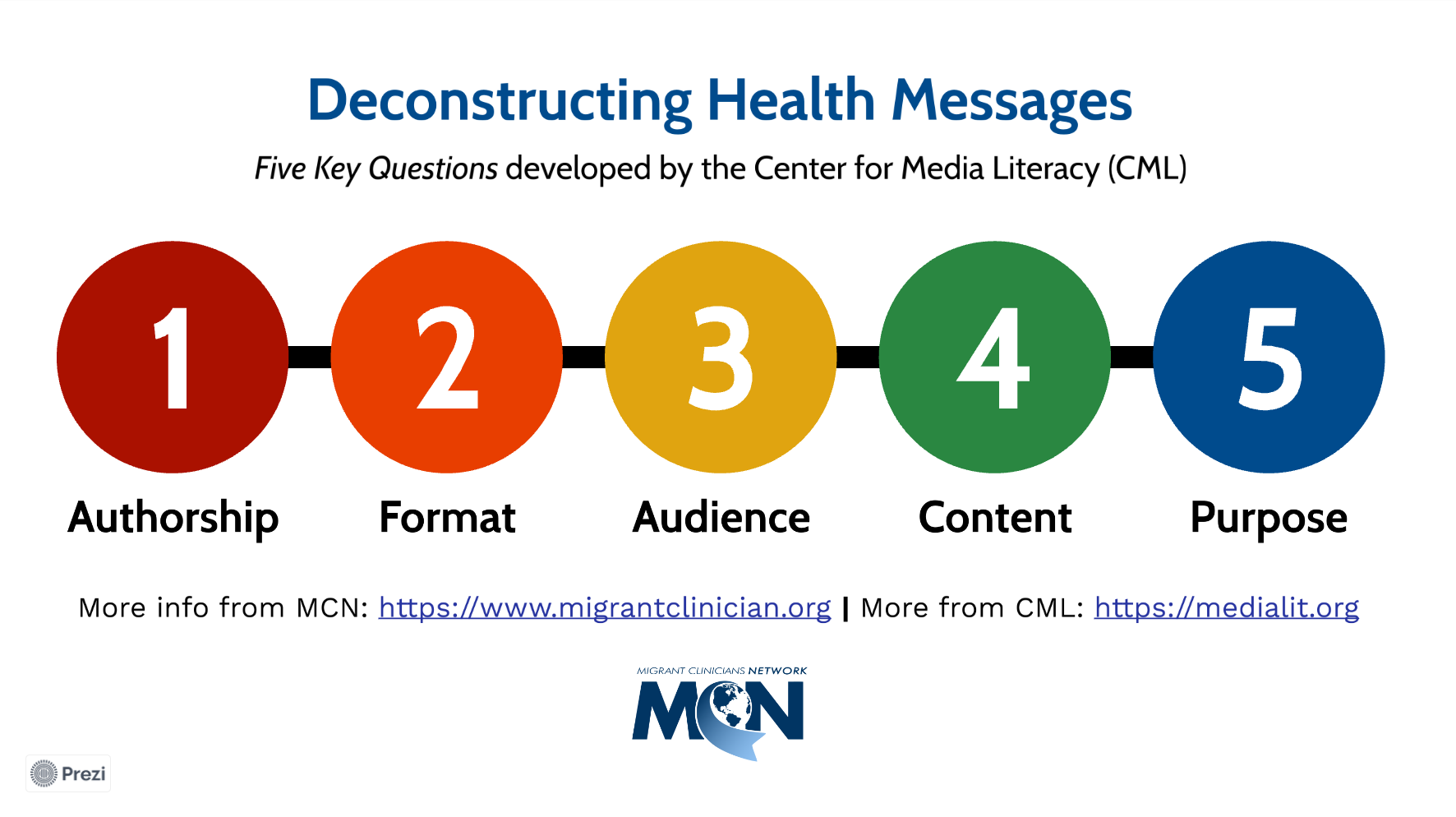
Title screen of Deconstructing Health Messages Prezi Presentation

The analysis encouraged by these Five Key Questions, developed by the Center for Media Literacy (CML), can inform the decision-making or actions that we may take in a media-driven world.

A Prezi presentation that includes the Five Key Questions accompanied by links out to related resources is available to view here: https://prezi.com/view/2zUKL4KGQWaysr1BertD/

MCN Webinar - Treating Global Health At Your Doorstep Starts with a Good Patient History

DATE: September 8, 2020


Description

Health Network assures continuity of care and treatment completion by providing comprehensive case management, medical records transfer, and follow-up services for mobile patients. During this webinar, you will learn how to enroll a patient in Health Network, strategies for incorporating Health Network into your existing clinic systems, and the steps Health Network associates take to ensure continuity of care for your patients while keeping your clinic informed of patient outcomes.

This project is supported by the Health Resources and Services Administration (HRSA) of the U.S. Department of Health and Human Services (HHS) under cooperative agreement number U30CS09742, Technical Assistance to Community and Migrant Health Centers and Homeless for $1,094,709.00 with 0% of the total NCA project financed with non-federal sources. This information or content and conclusions are those of the author and should not be construed as the official position or policy of, nor should any endorsements be inferred by HRSA, HHS or the U.S. Government.


The Environmental Protection Agency’s (EPA) Worker Protection Standard (WPS)protects agricultural workers from the health risks associated with pesticides. The WPS requires agricultural employers to comply with minimum safety precautions when using pesticides on farms and in nurseries, greenhouses or forests. Requirements include: training of workers handling pesticides or working in treated areas, provision of adequate personal protective equipment (PPE), communication of information about work areas recently treated with pesticides and when it is safe to re-enter these areas, and in case of emergency, availability of decontamination facilities and provision of medical assistance. The following guide reflects the WPS provisions currently in effect, which were last updated in 2015.

Files


Worker Protection Standard Pesticide Safety Training Curriculum - Culturally and linguistically appropriate curriculum with supporting resources for training workers on the revised Worker Protection Standard. Developed by the Florida State University PISCA Project and Migrant Clinicians Network.

The New England Journal of Medicine has an article analyzing early cases in China which gives some clarity around how the virus works: “Clinical Characteristics of Coronavirus Disease 2019 in China".

The CDC’s archived webinar from last week provides a useful overview for clinicians: “Coronavirus Disease 2019 (COVID-19) Update—What Clinicians Need to Know to Prepare for COVID-19 in the United States.”

This almost real-time map shows where COVID-19 cases have been reported, all over the world, which provides some perspective and allows for a visual understanding of the spread as it progresses. 

NACHC’s new FAQ runs down a number of additional resources not covered here, specifically tailored for health centers. 

HRSA’s new COVID-19 FAQs give some overview on the health center requirements around emergency preparedness as well as recommendations for communications from health centers.

This list of resources was selected because of the breadth of languages and the simplicity of the infographics. 

APHA's Get Ready campaign helps Americans prepare themselves, their families and their communities for all disasters and hazards, including pandemic flu, infectious disease, natural disasters and other emergencies.

The Hesperian provides excellent patient education material on COVID-19 in a number of languagues for use internationally or with immigrant communiites in the United Sates.